
Gestalt theory
What Is Gestalt Psychotherapy?
Gestalt psychotherapy is a humanistic and experiential approach to therapy that emphasises awareness, authenticity, and personal responsibility. It focuses on helping individuals become more fully aware of their present-moment experiences, including thoughts, emotions, bodily sensations, behaviours, and interactions with others. Rather than analysing problems solely through interpretation or diagnosis, Gestalt therapy encourages clients to experience themselves more clearly in the here and now.
Gestalt therapy views psychological distress as arising when people become disconnected from aspects of their experience or rely on rigid patterns of coping that were once adaptive but are no longer helpful. The aim of therapy is not simply symptom reduction, but increased self-support, integration, and the capacity to respond creatively to life situations.
Origins and Historical Background

Gestalt psychotherapy was developed in the 1940s and 1950s through the work of Friedrich (Fritz) Perls, Laura Perls, and Paul Goodman. Although Fritz Perls is often the most recognised figure, Laura Perls made substantial theoretical and clinical contributions, particularly in emphasising contact, relationship, and phenomenological awareness.
Time period: Mid-20th century (1940s–1950s)
Geographical roots: Europe (Germany and South Africa), later established in the United States.
Key Influences:
Gestalt psychology: Emphasised perception as organised wholes rather than isolated parts, influencing Gestalt therapy’s holistic view of human experience.
Psychoanalysis: Early Gestalt therapy emerged as a reaction against classical Freudian analysis, particularly its emphasis on interpretation and the past.
Existential philosophy: Contributed ideas about freedom, responsibility, choice, and authenticity.
Phenomenology: Encouraged focus on direct, observable experience rather than theoretical assumptions.
Gestalt therapy became closely associated with the humanistic psychology movement of the 1960s and 1970s and influenced later experiential and relational therapies.
Main Concepts and Contributions
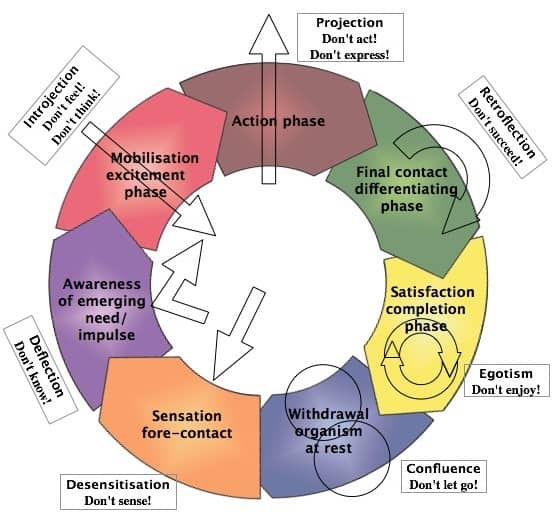
Gestalt psychotherapy introduced several influential concepts that continue to shape contemporary psychotherapy.
1. Here-and-Now Awareness
Gestalt therapy emphasises present experience rather than extensive exploration of historical causes. While past experiences are acknowledged, they are explored as they arise in the present moment. Clients are encouraged to notice what they are experiencing right now—emotionally, cognitively, physically, and relationally.
2. Holistic View of the Person
Individuals are understood as integrated wholes, inseparable from their environment. Thoughts, emotions, body sensations, and social context are all seen as interconnected. Symptoms are not viewed in isolation but as meaningful expressions of the whole person’s current way of functioning.
3. Personal Responsibility and Choice
Gestalt therapy emphasises helping clients recognise their role in shaping their experiences. This does not imply blame, but rather empowerment. Clients are encouraged to acknowledge their feelings, needs, and behaviours and to explore their capacity to make choices rather than feeling controlled by circumstances.
4. Figure–Ground Formation
This concept describes how attention naturally shifts, with certain needs or experiences coming into focus (figure) while others remain in the background (ground). Psychological difficulties can occur when important needs are ignored, avoided, or left unresolved, disrupting natural awareness and satisfaction.
5. Unfinished Business
Unfinished business refers to unresolved emotions, conflicts, or experiences—often from earlier relationships—that continue to influence present behaviour. These unresolved experiences may manifest as recurring emotional reactions, self-criticism, or relationship patterns. Gestalt therapy aims to bring these experiences into awareness so they can be integrated.
6. Contact and Boundaries
Healthy functioning involves effective contact with others and the environment while maintaining a clear sense of self. Gestalt therapy explores boundary disturbances such as withdrawal, avoidance, or over-involvement, helping clients develop more flexible and authentic ways of relating.
7. Experiential and Creative Techniques
Gestalt therapy is known for its use of experiential methods designed to deepen awareness. Techniques are used as experiments rather than fixed interventions. The empty chair technique, role-playing, guided dialogue, exaggeration of gestures, and body-focused awareness are commonly used to explore internal conflicts and relational patterns.
How Gestalt Psychotherapy Is Used in Practice

Gestalt therapy can be applied in individual, group, couples, and family therapy settings. The therapeutic relationship is central, with the therapist actively engaging with the client collaboratively and authentically.
Therapeutic Process:
Therapists encourage clients to describe experiences rather than analyse or explain them.
Attention is given to nonverbal communication such as posture, facial expression, breathing, and tone of voice.
Clients may be invited to enact or experiment with different ways of expressing thoughts or emotions.
The therapist may draw attention to what is happening between the client and therapist as a reflection of relational patterns.
Common Areas of Application:

Anxiety and depression
Relationship and attachment difficulties
Trauma and unresolved emotional experiences
Identity, self-esteem, and personal growth issues
Stress, life transitions, and emotional regulation
Summary
Gestalt psychotherapy is a holistic, experiential approach that emphasises present-moment awareness, responsibility, and authen
tic contact. By focusing on lived experience and the integration of mind, body, and environment, Gestalt therapy has made significant contributions to psychotherapy and remains a valuable and influential therapeutic approach today.
Key Theorists and Influential Quotes
Fritz Perls:
"Awareness in itself is curative."
Laura Perls:
"Change occurs when one becomes what one is."
Paul Goodman:
"The self is not a thing, but a process."
Isadore From:
Therapy deepens awareness rather than controls behaviour.
Gary Yontef (contemporary Gestalt):
Gestalt therapy focuses on awareness, responsibility, and choice.


Comments